Rhythm Zone: You have structure. Now the question is whether it is aimed.
A dangerous thing can happen when the week becomes reasonably orderly. You stop testing whether the order is serving the right aim.
You probably think ahead. You probably protect some time. You probably have habits, planning points, calendar blocks, or some form of weekly review already in place. The week is not completely loose. There is some return, some shape, some evidence that you can hold a rhythm.
That deserves respect. But the danger of being functional is that it can quiet the sharper question. The calendar has shape. The week looks disciplined. Useful things are being done. And yet, underneath all of that, the decisive work can still be negotiated down.
Your Execution Baseline
This is where Rhythm sits in the AQMeets path.
Something is already working. The week is no longer merely floating. You have some capacity to return, review, plan, and hold a direction. That is why this zone deserves respect.
But it also deserves a sharper question. You are trying to make movement answer to a clearer aim.
This is where many capable people begin to plateau. The week has enough order to avoid obvious drift. It has enough movement to avoid obvious stagnation. But movement may remain too comfortable, review may remain too private, and the rhythm may stay weakly connected to the larger aim.
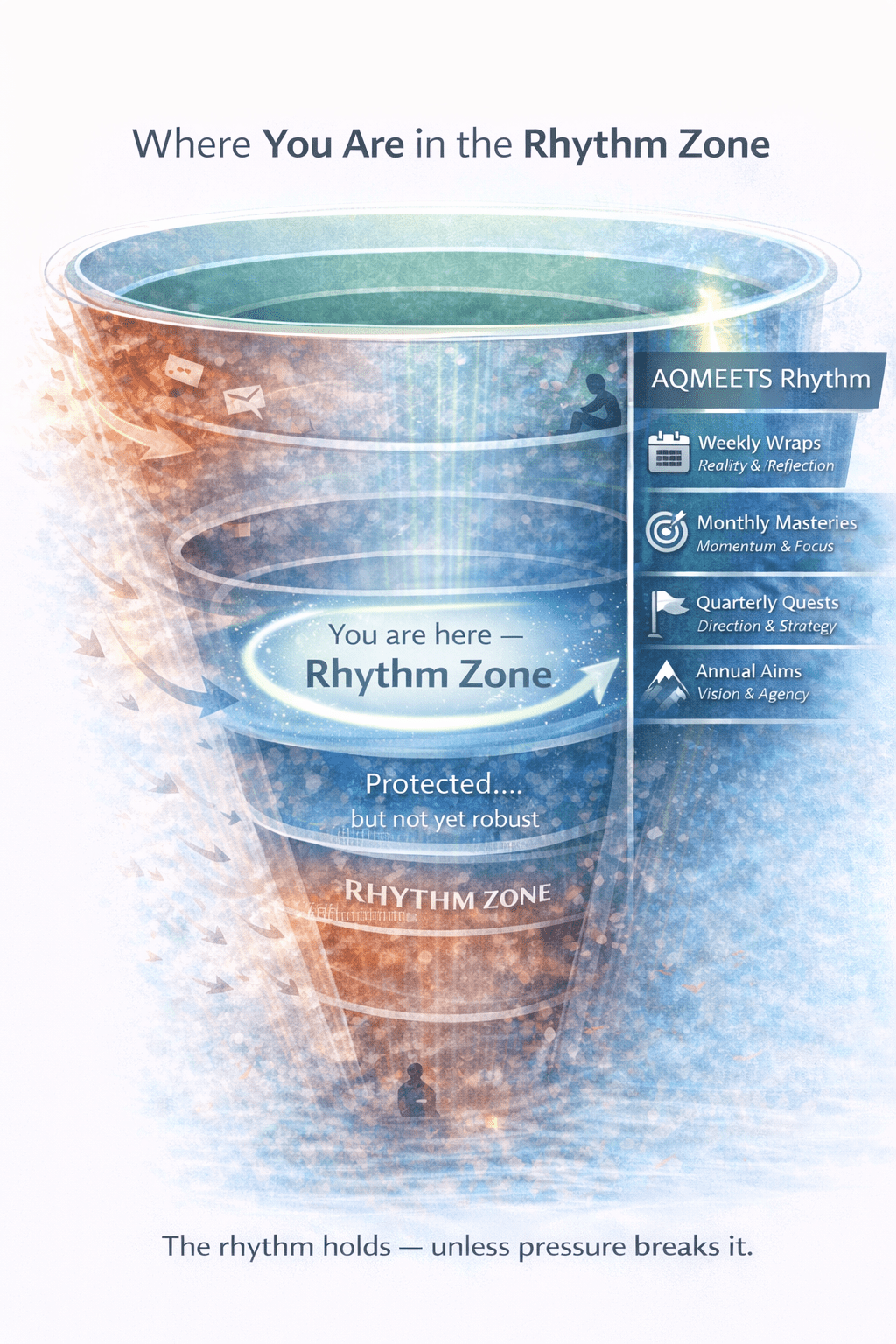
Watch this Rhythm Zone orientation.
Watch this before you choose your next step, because Rhythm Zone is easy to underestimate. It feels like progress, and often it is.
Progress that is never tested against proof can become a comfortable form of delay. Structure alone is not the question now. The question is whether the structure is strong enough to compound.
Start the Free Trial and Tighten Your RhythmWhat Rhythm usually means.
Rhythm Zone means structure is present, but the rhythm is not yet carrying enough weight.
Workable cadence.
Something has already been built. You may have routines, planning habits, review habits, calendar blocks, or a reasonable weekly rhythm. Now the cadence has to become robust.
Softened aim.
The person knows what matters, but the edge has dulled. The aim is present enough to guide general direction, but not sharp enough to govern difficult choices.
Private correction.
Because you are functioning, you may keep correcting alone. But private correction often lets you remain your own easiest judge.
This is where capable people plateau. They have enough order to avoid obvious drift, but not enough refinement to produce compounding evidence.
Consistency can also become a hiding place.
A person can show up regularly and still avoid the decisive work. A calendar can look disciplined while the larger aim remains under-served.
The calls happened. The client work was delivered. The review was done. The week looked respectable. But the one strategic asset that would have changed the quarter is still half-built.
A year can pass in orderly weeks that never compound.
Maintenance can feel responsible while the larger work remains underdeveloped.
For a founder, this may look like steady client delivery while the offer, sales system, or strategic asset remains unfinished.
For a consultant, delivery may continue while positioning stays vague.
For a leader, meetings and responsibilities may keep moving while the hard decision remains untouched.
Workable cadence, softened aim, private correction.
Rhythm usually has three movements beneath it.
Workable cadence
You can return to the week. You can make plans. You can hold routines. You can protect some work. This is real progress. Now cadence has to become robust.
Softened aim
The week remains orderly, but the aim does not command it. And when the aim does not command the week, the week gradually negotiates the aim down.
Private correction
You notice what happened. You adjust. You make sense of the week privately. But without stronger review, the same pattern can keep returning in a more respectable form.
A rhythm that only works in clean conditions is fragile. It has to survive pressure, interruption, fatigue, shifting demands, and the ordinary disorder of a real week.
Tighten the feedback loop.
The week already has some shape. Now the review has to name the aim, the movement, the proof, and the place where the week softened.
At this level, the problem is usually under-leveraged rhythm. The person can keep going. The person can maintain some structure. But the structure is not yet strict enough with the aim.
Effort has to answer to proof.
A tighter feedback loop helps the week answer to the quarter. It helps the quarter answer to the year. It helps effort answer to proof.
Pro brings review, correction, and peer proof into the cadence, so the week is no longer judged only by private impressions.
- Name the aim clearly.
- Review what actually moved.
- Raise the proof standard.
- Make the next correction visible.
Why the free 14-day Pro trial matters.
The free 14-day Pro trial lets you test what happens when your existing rhythm is brought into the AQMeets cadence.
You bring the rhythm you already have. We help you see where it is strong, where it softens, and where the next refinement belongs.
For 14 days, you get to ask a more advanced question: “What happens when the rhythm I already have is placed under a clearer aim and a tighter review?”
You bring your real rhythm.
AQMeets helps you examine it, aim it, and begin tightening it.
The trial gives you a way to test the answer before making the decision larger than it needs to be.
This is refinement. Not another vague promise to be better next week.
What the induction gives you.
The induction gives your trial a serious beginning. It begins with the cadence you already have and helps bring it into clearer view.
A clearer diagnosis.
You should see where the week is already working and where it remains under-aimed.
A first refinement point.
The rhythm has to become exact enough to serve what matters. The induction helps locate the first place to tighten.
A cleaner path decision.
You should have a better sense of whether your next path is Lite, Pro, or Leader.
Rhythm Zone usually needs precision. The rhythm has to become exact enough to serve what matters.
“Well enough” is the most expensive phrase in Rhythm Zone.
In Drift, hesitation often comes from discouragement. In Busy, it often comes from overload. In Rhythm, hesitation often comes from adequacy.
Things are working well enough. And that can keep the decisive work out of sight.
You have already built enough to refine.
The question is whether you will use that rhythm to compound, or allow it to settle.
A working rhythm deserves more than maintenance. It deserves a stronger aim, a tighter review, and visible proof.
What your first 14 days should do.
The next 14 days should help you test whether your existing rhythm becomes stronger inside a more exact cadence.
We look at your rhythm.
Where does it work? Where does it soften? Where does the week still lose contact with the larger aim?
We find the softened aim.
The aim must become strong enough to decide what is protected, refused, and measured.
The week is reviewed.
What moved? What was avoided? What softened? What must be corrected before the next cycle?
The proof standard rises.
You may be counting activity when the real question is movement.
You decide from evidence.
Did AQMeets sharpen the rhythm you already had and make proof more visible?
By the end of the trial, you should know whether your current rhythm is merely keeping you organised, or whether it can be made strong enough to compound.
Which AQMeets path fits Rhythm Zone?
For Rhythm Zone, the first step is usually the free 14-day Pro trial.
Pro is the natural test.
Rhythm Zone needs a fuller cadence of review, correction, and peer proof. Pro lets you test that without overcommitting first.
Lite may still fit some.
Lite may be suitable if your rhythm is simple, personal, and low-stakes. But many Rhythm Zone people carry more responsibility than that.
Leader may be the better path.
If the problem is not the weekly rhythm itself, but the strategic decisions the rhythm is serving, book the onboarding call.
Leader is often for higher-order judgment, especially when the decisions above the rhythm need counsel.
AQMeets Pro should not add unnecessary complexity to a rhythm that already exists.
It should make the rhythm more exact.
It replaces “I am generally on track” with a clearer answer to the harder question: “Is the right work actually moving?”
The aim is to make your rhythm answer to the work that matters.
It replaces vague consistency with reviewed cadence.
It replaces private correction with stronger feedback.
It replaces useful activity with proof that can be examined.
Rhythm Zone is easy to coast in because it feels respectable.
You are planning. You are reviewing. You are doing useful work. You may be more consistent than most people around you.
A year can pass this way. Useful weeks. Reasonable progress. Some wins. Some proof. But not the deeper compounding movement that should have been possible.
Your rhythm is too valuable to leave under-aimed.
You do not need to start from zero.
You need one serious cadence that helps your existing structure answer to a clearer aim.
The next 14 days are free. Use them properly.
Start AQMeets Pro and let us help you tighten the rhythm you already have through the guided induction.
By this time in two weeks, the aim is not that your whole life has been redesigned. The aim is that your rhythm has been reviewed, the softened aim has been seen, and one first refinement has been made.