
Pursue what matters.
Learn from what happens.
A worthwhile goal deserves sustained effort. Pursuing it also requires judgment: what to continue, what to change and how the work fits with your responsibilities.
AQMeets brings these decisions together through Fractal Feedback, a practice that connects daily action with longer-term direction.
You work towards something you want to achieve. You examine your experience. What you learn informs your next decision.

Keep your goals and your experience in conversation.
You can have a meaningful goal, a carefully planned week and useful lessons from experience, yet struggle to connect them.
A difficulty keeps recurring, but the larger plan remains unchanged. A successful approach produces an unexpected result, but you never examine what made it work. An important decision is made during an annual review, then disappears from the weeks that follow.
AQMeets is built around a conviction: our plans should guide our actions, and our experience should inform our plans.
That requires regular occasions to look carefully at what happened, exercise judgment and carry a decision into practice.

Achieve. Adapt. Integrate.
These three concerns shape the programme.
Achieve something worthwhile.
Bring your intentions into practical form.
Choose what you want to accomplish, decide what it requires and make commitments you can act on. Give the work sustained attention and examine the results.
Completed projects, stronger capabilities and responsibilities carried well all matter. AQMeets provides a structure for working towards them.
Adapt through experience.
Use what happens to improve your approach.
You may discover that an estimate was unrealistic, a skill needs development or a method is particularly effective. Some findings call for a small adjustment. Others deserve a wider review.
Adaptation includes recognising what works, understanding its contribution and deciding where to use it again.
Integrate your ambitions with your responsibilities.
Consider the place each pursuit occupies in your life.
Your time, energy and resources are finite. A new commitment affects the work you already carry, the people who depend on you and the attention available for other priorities.
Integration means making those choices deliberately, with regard for both your aspirations and your obligations.
Fractal Feedback connects the decisions.
A daily action and an annual priority require different kinds of attention. They still need to inform one another.
Fractal Feedback connects five scales of planning and review: daily, weekly, monthly, quarterly and annual.
At each scale, you examine the experience relevant to the decision:
- Daily actionsWhat needs doing, and what are you noticing?
- Weekly commitmentsWhat happened to the work you intended to complete?
- Monthly patternsWhich habits, capabilities or working arrangements need attention?
- Quarterly strategyHow well is your approach serving the goal?
- Annual prioritiesWhere should your finite time and resources go?
The connection runs both ways. Longer-term decisions guide present action. Evidence from the work can prompt you to examine a method, a strategy or a larger commitment.
Once you make a decision, you carry it back into what you do.
You can address an issue when it becomes clear. It does not need to pass through every review.
Explore Fractal FeedbackLook closely at what the result is telling you.
Suppose you expected a project to take three work sessions. It took five.
That difference may call for a better estimate next time. Whether the finished work met the required quality is a separate question.
A useful review distinguishes the result you observed, the prediction you made and the standard you intended to meet. It then examines possible explanations.
Perhaps the task was unfamiliar. Perhaps interruptions reduced the available time. Perhaps your method was inefficient.
Those explanations suggest different responses. The purpose of review is to understand enough to choose responsibly, while recognising what remains uncertain.

Learn from success, too.
Imagine you change how you prepare for client meetings. The conversations become more useful, and fewer questions remain unresolved afterwards.
That is worth examining.
Which part of the preparation helped? Has the improvement occurred consistently? Could the same approach help someone else on your team?
If the evidence supports it, you can make the preparation part of your regular practice and review its effect over time.
Fractal Feedback helps you retain useful learning and apply it beyond the occasion that first revealed it.

Practise the judgment you want to develop.
The way you pursue a goal can strengthen your capacity to direct your own work.
Following through can develop reliability. Examining a mistake honestly can improve judgment. Asking for assistance can help you recognise the limits of your knowledge and resources.
AQMeets gives recurring attention to four faculties involved in these decisions:
Awareness
Notice what happened, including what you completed, what changed and what you overlooked.
Reason
Examine explanations and distinguish what the evidence supports from what remains uncertain.
Imagination
Consider other approaches and the possibilities they might create.
Will
Choose an appropriate commitment and carry it into action.
These capacities develop through use. Regular review gives you occasions to exercise them in the circumstances of your own life.
A difficult week needs to be understood in context. Its results alone cannot tell the whole story of your effort, decisions or character.
Give your ambitions a wider frame of reference.
An opportunity may advance your business while demanding more time than you can responsibly give it. A project may remain worthwhile even when progress is slow. A responsibility may deserve sustained attention without producing a visible accomplishment.
Higher Horizons helps you examine these choices in relation to the wider direction of your life.
It brings four fields into consideration:
- Far HorizonWhat do you hope to build or become over the longer term?
- LifetimeWhat deserves attention within the life available to you?
- LegacyWhat might your choices leave with other people?
- EternalWhat ultimate commitments and standards should govern your purposes and your conduct?
These considerations provide orientation for your plans and actions.
Your Higher Horizons Charter records your current direction, responsibilities, boundaries and unresolved questions. It gives you something explicit to work from and revisit as your understanding develops.
You can begin with a goal you already intend to pursue. Wider reflection develops alongside the practical work.
Explore Higher HorizonsTake responsibility for what you can carry.
Choosing a priority involves deciding what will receive fewer resources, what can wait and what you will decline.
Sometimes the appropriate response is greater persistence. Sometimes you need more knowledge, a different method, practical assistance or time to recover.
A considered review can lead to a renewed commitment, a smaller scope or a well-founded decision to stop.
AQMeets asks you to examine these choices honestly. The aim is to make commitments you can responsibly carry and revise them for reasons you can account for.

Our foundations.
AQMeets draws on a Christian understanding of the person, moral responsibility and the formation of character.
This informs our attention to the purposes we pursue, the means we use and our obligations to others. It also informs our conviction that achievement should serve a worthwhile life.
Members are welcome without being required to profess the Christian faith. Personal reflection can remain private, and sharing Higher Horizons reflections with peers is optional.
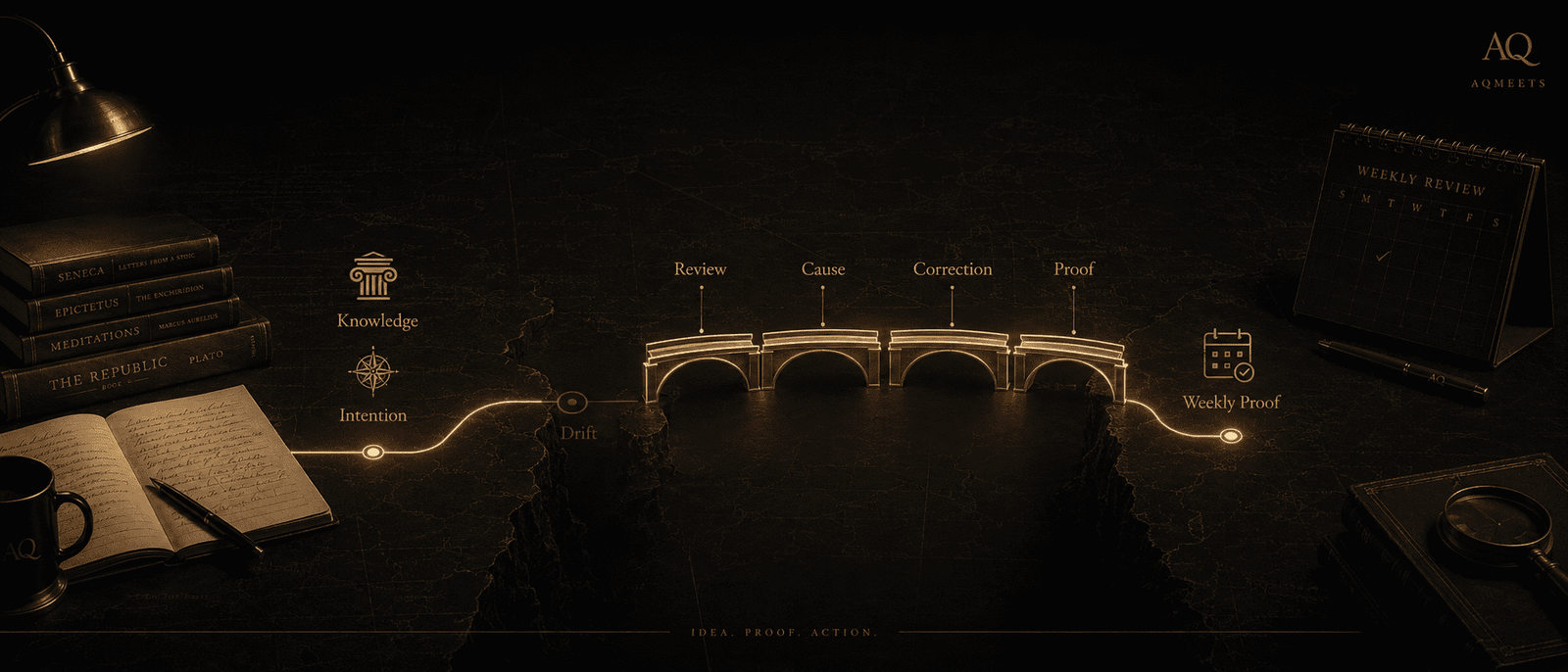
Put the philosophy into practice.
In AQMeets, you apply these ideas to your own work through teaching, guided workbooks and recurring reviews.
You make practical commitments, examine results and record decisions that inform what happens next. Your membership determines the facilitated reviews and private support available to you.
The aim is worthwhile achievement supported by retained learning and stronger self-direction.
That may mean completing a project, developing a capability, sustaining an important responsibility or changing an approach that no longer serves its purpose.

Begin with something worth your attention.
Bring a goal you want to pursue or a responsibility you want to carry better.
Choose a practical commitment. Give it room in your week. Examine what happens and use what you learn.
AQMeets provides a structure for continuing that practice and connecting it with the larger direction of your life.
Prefer to reflect on your current approach first?
Take the Execution Scorecard