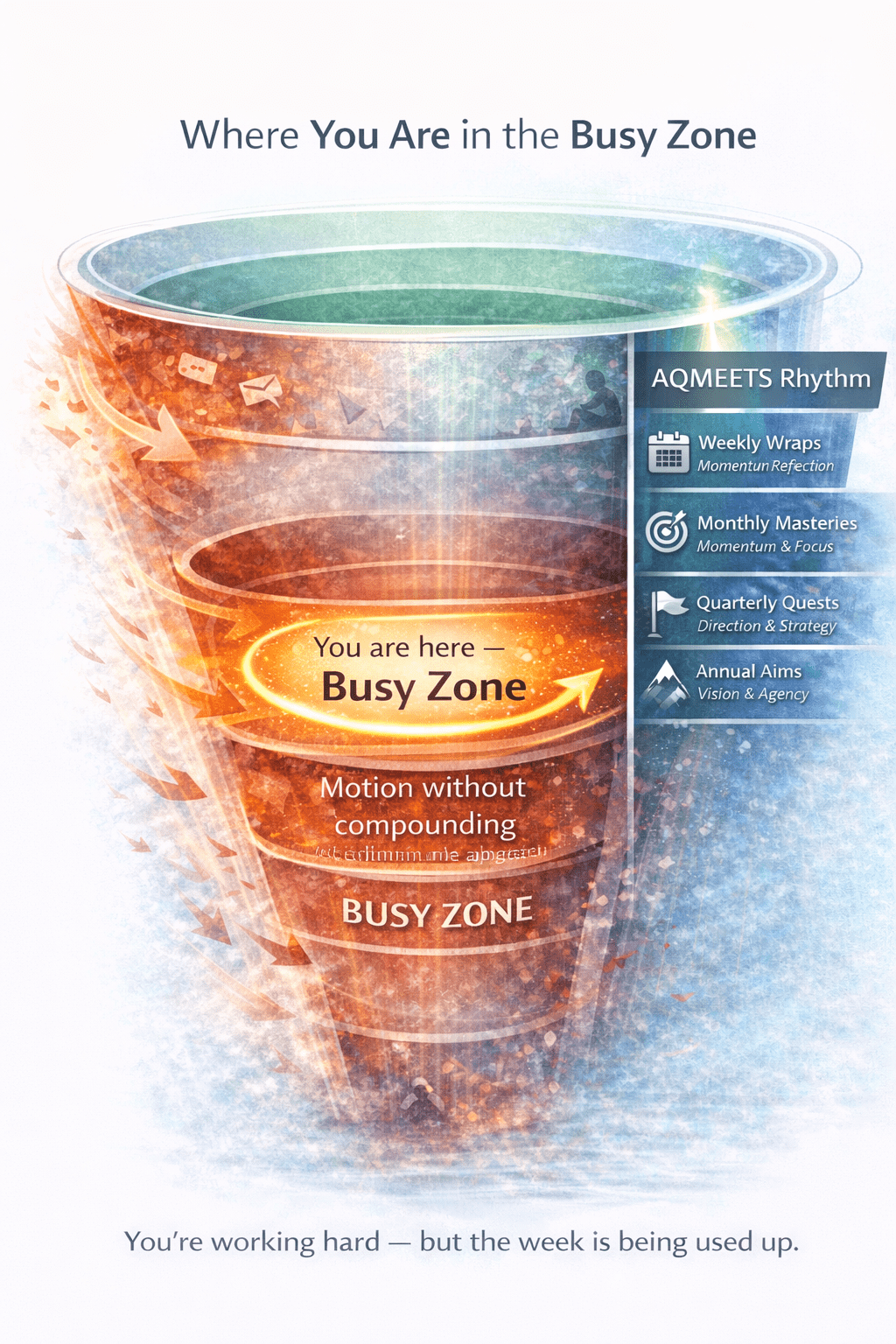
Busy Zone: The week is full. But how much of your effort reached the work that matters?
You reach Friday with plenty completed, yet the strategic priority you named at the start of the week is still waiting.
Clients were answered. Decisions were made. Problems were solved. The business kept moving. Your effort is real. The uneven part is the evidence on the work that should change the quarter.
That is the Busy pattern: high effort with uneven proof. Urgent and externally accountable work keeps receiving force, while your own important priorities are repeatedly asked to survive on what remains.
Your Execution Baseline
Your result shows strong effort with an allocation problem inside the week.
Busy sits above Drift because you already have momentum. You can plan, decide and work. The difficulty is that the week still gives stronger consequences to clients, meetings, messages and urgent problems than it gives to the work only you can protect.
You do not need another lecture about working harder. The useful question is where your existing effort goes, what the week actually produces, and whether what happened is changing the way you approach the next one.
The next step is a stronger feedback rhythm: bring intention into contact with the week you actually lived, learn from the difference, and carry one useful correction forward.
Watch this before you decide what to change.
Busy can survive ordinary planning because Monday can restore the priority without explaining why it lost the previous week. Plenty keeps happening, so the allocation problem remains easy to miss.
By Thursday, the inbox may be clear, a client problem may be solved and several useful tasks may be finished. The priority you named on Monday can still be sitting in the same place.
Start the Free 14-Day Pro TrialWhat Busy looks like in a capable week.
Busy is a high-functioning execution problem: enough gets done to keep the week working, while evidence on the most consequential work remains inconsistent.
High effort, uneven proof.
You can arrive at Friday with twenty completed tasks and still have little to show on the priority that was supposed to matter most. The task count is real; it simply measures something different from strategic movement.
Urgency has stronger consequences.
Client work has a deadline. Staff need answers. Problems create immediate consequences. Your own strategic work can be postponed with surprisingly little pain today, even when the cost becomes obvious later.
Monday restores the plan.
The neglected priority returns to the list on Monday. If the previous week was never examined, the plan comes back without an instruction about the conditions that defeated it.
A new plan on Monday cannot correct a cause you never examined.
Busy can persist precisely because you are capable.
Enough gets done to keep the system functioning.
You can absorb pressure, recover a neglected task, satisfy other people and keep the week from visibly failing. That competence buys the pattern more time.
The cost therefore appears less in collapse and more in the work that never receives sustained force.
A busy season can hide a repeating pattern.
Some seasons really are unusually demanding. The useful signal is repetition. If the same important work keeps moving to “soon” across several weeks, the calendar is giving you information about the system.
The next move is to stop treating each Monday as a fresh start and begin learning from the week that just happened.
Busy produces plenty of experience. Too little of it changes the next week.
The gap usually appears between planning, the reality of the week, and the correction that should follow.
The plan returns
You begin with a priority and a reasonable plan. The intention is present. What is often missing is a reliable way to compare that intention with the week once reality has had its say.
Reality reallocates the week
Clients, meetings, delays, new information and attractive side ideas compete for the same hours. Some deserve attention. The pattern becomes costly when the same forces repeatedly displace the strategic work.
Learning arrives too late
If Friday is never compared honestly with Monday, the next week begins with another plan rather than a correction drawn from evidence. Experience happened, but too little of it became instruction.
Drift grows in the gap between intention and feedback. Busy can hide that gap beneath a great deal of useful activity.
Why the free 14-day Pro trial matters.
You can build this feedback practice yourself. The Pro trial lets you experience the full architecture before deciding whether you want to keep recreating it on your own.
Feedback Analysis is the principle. Fractal Feedback applies that principle across the year, quarter, month, week and day. The Rhythm is the recurring practice. AQMEETS is the environment in which those review points, prompts and live sessions already exist.
For Busy Zone, the test is narrow on purpose: choose one important priority that has been carried forward too many times and see whether a stronger feedback rhythm changes what happens to it.
Test AQMEETS against one neglected priority.
Use the same kind of week you normally live. Keep the clients, meetings, interruptions and competing responsibilities in the test.
At the end, judge the method by evidence: did the priority receive protected time, did something concrete move, and did the week teach the next one anything useful?
What the induction gives you.
The induction turns your Busy result into a working experiment. You bring the responsibilities and system you already use; the goal is to make the important work more visible and the feedback more precise.
A clearer direction.
You name the larger direction, narrow the competing aims and choose the Quarterly Quest that deserves force now. The calendar begins answering to a smaller number of deliberate commitments.
A visible test.
You define what evidence would show that the quarter moved, then reduce it to something this month and this week can actually produce. The review has something concrete to examine.
A response when pressure returns.
You identify the first signs that urgency is taking over and prepare a practical response. The objective is to notice the shift sooner, correct deliberately and return before one disrupted day becomes another lost week.
The induction should leave you with an instruction for the week, not simply a better description of the problem.
A protected Weekly Wrap.
For Busy Zone, the Weekly Wrap is where the week stops being a collection of tasks and starts becoming feedback.
You compare what you intended with what actually happened while the evidence is still fresh, identify where effort was redirected, and choose one correction that the next week can use.
Turn the week into feedback.
- What did I intend?
- What actually happened?
- What does the evidence teach me?
- What changes now?
Planning sets direction. Feedback lets reality improve it. The Weekly Wrap gives that learning a fixed place before Monday asks you to begin again.
Why AQMEETS Pro is the recommended path.
Lite may suit someone whose main need is a lighter weekly and monthly structure. Busy Zone usually benefits from the full Rhythm because the allocation problem appears across more than one horizon.
Full Rhythm
Annual Aims, Quarterly Quests, Monthly Masteries, Weekly Wraps and Daily Directives keep the larger aim connected with ordinary time.
Feedback that travels
Learning from the day can inform the week; repeated weekly evidence can change the month or quarter. Intention flows down and feedback compounds up.
Peer Proof
Bringing evidence before other people makes it harder for a softened priority or easy explanation to survive inside a week that otherwise looks productive.
You are not joining AQMEETS to become busier. You are installing a Rhythm that helps your existing effort reach the work that matters.
What your first 14 days should test.
Use the fortnight to test one claim: a stronger feedback rhythm should direct more of your existing effort toward the priority you have been carrying forward.
Choose the neglected priority.
Name one piece of work that has survived in the “soon” category despite all the activity around it. That becomes the test case.
Enter the full Rhythm.
Put the Daily Directive, work blocks and Weekly Wrap into a real calendar, with the larger monthly and quarterly aim visible above them.
Bring back visible evidence.
Look for something completed, sent, decided, recorded or shown. Then use the review to understand why it moved or why it did not.
You decide from evidence.
At the end of the fortnight, ask whether the feedback improved the second week. That is a more useful basis for a membership decision than enthusiasm at signup.
The trial has one job: make the work that matters harder to carry forward untouched.
AQMEETS should reduce the hidden labour of rebuilding the week.
Without a dependable feedback rhythm, each Monday asks you to recover the priority, reconstruct the plan and hope the same conditions do not win again.
With the Rhythm in place, the week reports back. What happened becomes information, and one useful correction can enter the next cycle.
Your week should stop starting from zero.
A reviewed week gives the next week information. You begin with something reality has taught you rather than another untouched version of the same plan.
The gain is cumulative: more of your effort reaches the aim, and the feedback makes the next allocation more intelligent.
Busy can continue for a long time because enough keeps working.
There may be no dramatic event forcing a change.
If the same important work keeps moving to next week while everything around it continues to function, treat the repetition as evidence. Review the pattern before another quarter quietly inherits it.
Direct more of your effort toward what matters.
You already know how to work. Use that strength.
Enter the Rhythm with one neglected priority and give the week a fixed place to report back.
Feedback takes time. Drift takes more.
Use the 14-day Pro trial to experience the daily-to-annual architecture, not merely read about it.
At the end of two weeks, judge AQMEETS by evidence: did the priority move, did you see where your effort was being allocated, and did one correction make the second week better than the first?