Compounding Zone: Your execution is strong. What deserves its force next?
Your score suggests that much of the machinery of execution is already working. Important work receives time. Commitments are usually kept. Review and recovery are familiar rather than exceptional.
That changes the kind of question worth asking. The useful question now is whether the aims, assumptions, and decisions directing this capacity still deserve to be carried forward with the same force.
Execution capacity multiplies whatever governs it. When the direction is sound, a dependable rhythm carries good work further. When circumstances change, the same strength can keep an old decision moving long after it deserves re-examination.
Your Execution Baseline
Compounding is a strong result. It changes the kind of question worth asking.
Your answers suggest that rhythm is no longer theoretical. You can turn intention into action with reasonable consistency, recover when the week is disrupted, and produce evidence rather than living only in plans.
At this level, a small error in direction can travel further because the system is good at carrying decisions into action. That does not mean your present direction is wrong. It means strong execution deserves periodic calibration.
The Scorecard measures the machinery of execution. It cannot decide whether a current aim still deserves that machinery. That judgment remains yours.
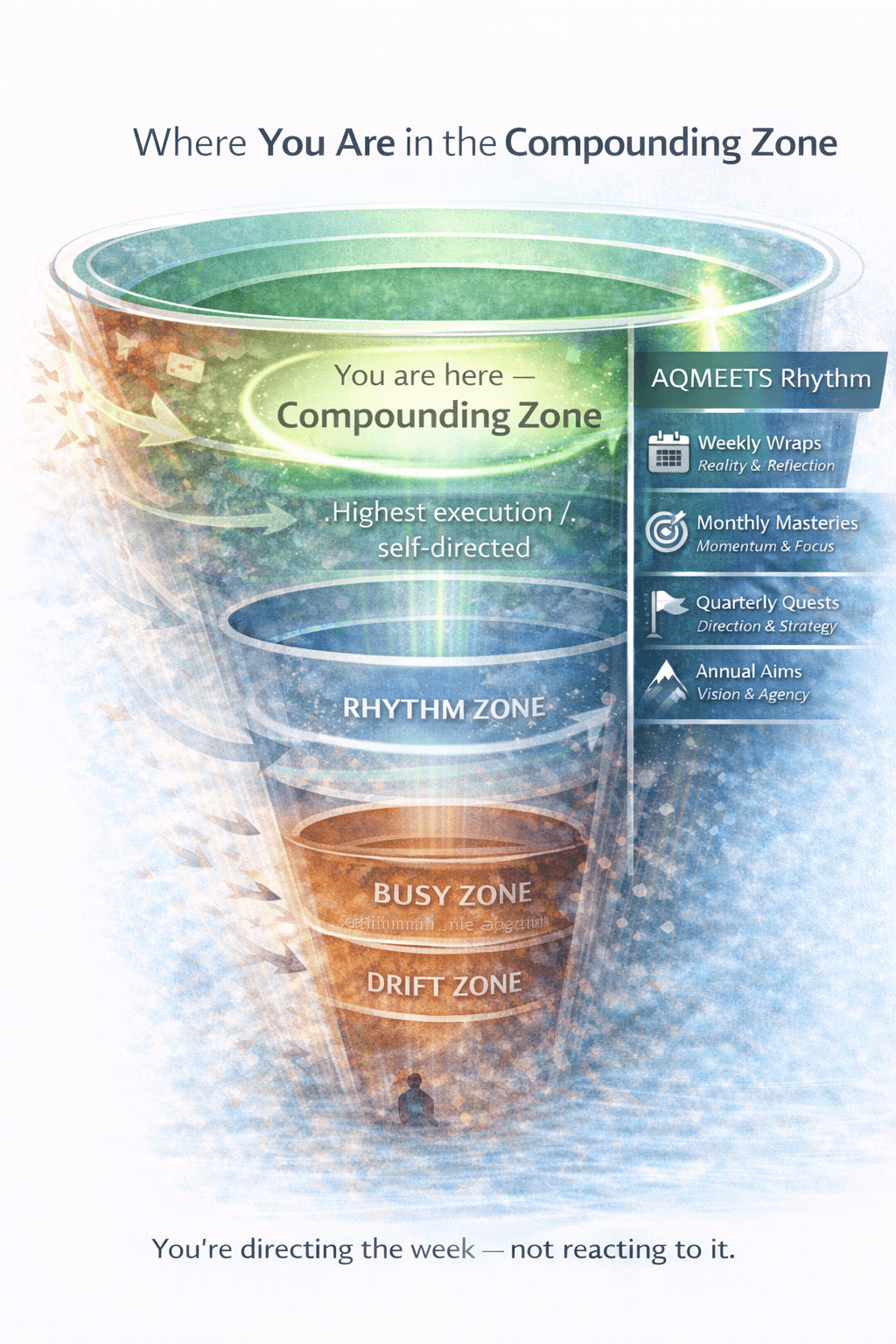
Watch this Compounding Zone orientation.
Watch this before choosing your next step. A high score is useful evidence about how you execute; it is not a verdict on what you should pursue.
The rhythm already works. At Compounding level, ask whether its results, learning, and demands still serve what matters.
Book a Compounding Calibration CallWhat Compounding usually means.
Compounding means the execution rhythm is producing more than isolated activity. Results, learning, and agency are beginning to accumulate.
Results are accumulating.
Important intentions are becoming visible in the world: work gets finished, decisions get made, and commitments survive ordinary disruption. The rhythm produces evidence often enough to be trusted.
Learning can travel.
A reviewed week can improve the next week. Repeated evidence can change a month or quarter. Feedback is no longer only a record of what happened; it can improve the next cycle.
Agency is growing.
You are becoming better able to notice what is happening, interpret it, correct deliberately, and return. That growing capacity for self-governance matters beyond any single project.
Compounding = Results + Learning + Agency. Each cycle should leave useful work behind and improve the judgment carried into the next one.
Strong execution makes direction more consequential.
Failure interrupts. Success often gives you reasons to continue, and many of those reasons may be perfectly sound.
As work succeeds, commitments gather around it: clients, staff, systems, recurring costs, promises, and expectations. A decision that once served you well can become expensive to revisit simply because so much has formed around it.
Periodic feedback matters because yesterday's good decision can keep issuing instructions after the situation has changed.
What is your rhythm multiplying?
A founder may be growing revenue and discover that the delivery model now asks for more time, management, or complexity than the original aim justified.
A consultant may be serving clients well while noticing that delivery leaves too little room to build the deeper asset that should shape the next stage.
A leader may keep an organisation moving efficiently while a decision about staff, partnerships, cash flow, or direction deserves more deliberate attention.
Strong systems need more than confirmation that they are working.
At this level, review moves beyond “Did I do what I said?” and begins testing direction, accumulated commitments, and what reality is teaching.
Test the direction
Ask whether you would deliberately choose this aim again given what you now know. The point is not to distrust success; it is to keep present reality involved in the decision.
Count the weight
Success adds commitments. Clients, staff, platforms, promises, recurring costs, and expectations all make continuation easier than reconsideration. Their cost belongs in the review.
Carry learning forward
A result is more valuable when it changes the quality of the next decision. The feedback from this quarter should be allowed to revise assumptions that were reasonable when the quarter began.
Remain faithful to what matters, not merely to what you previously decided.
Calibrate what receives the force.
Calibration compares present intention with present reality. It asks whether the work is producing what you expected, what the evidence has taught, and whether the assumptions above the plan still hold.
For a Compounding person, the relevant questions often sit above the task level: aim, trade-offs, commitments, and the quality of the judgment governing the rhythm.
Reality before narrative.
Bring one part of your work that is succeeding and place the actual evidence on the table.
Look at what it now asks from your time, relationships, attention, money, and future commitments.
- What did I intend this to create?
- What is it actually producing?
- What has changed since I chose it?
- What should I continue, change, stop, or protect?
A strong system can benefit from an outside set of eyes.
At this level, another planning template is unlikely to be the main need. A useful conversation can test assumptions, expose trade-offs, and improve the quality of the next decision.
Think of an experienced person in a good gym. Strength does not remove the value of a knowledgeable coach. As the training becomes more advanced, programming, recovery, technique, and small corrections often matter more.
You remain responsible for the mission. Counsel is useful when it sharpens your judgment without taking ownership of that mission away from you.
The gym metaphor changes at Compounding.
In a gym, you do not have to make sports science your second profession before you can benefit from better training. You learn enough to participate intelligently, while a specialist concentrates on the mechanics, programming, and feedback around the work.
AQMEETS is built around the practice of motivation, feedback, and execution. Pro provides the full execution environment. Leader adds private Leadership Counselling when the decisions above the rhythm deserve more particular calibration.
Where Pro still fits when execution is already strong.
Use the trial first if you want to place your present system inside the full AQMEETS Rhythm before deciding whether private counsel would add value.
Bring something that already works.
Do not choose the weakest part of your week for this test. Bring an established project, process, or responsibility that already produces results and see what a stronger feedback environment reveals.
Let feedback cross horizons.
Annual Aims, Quarterly Quests, Monthly Masteries, Weekly Wraps, and Daily Directives connect the horizons of execution. Intention flows down. Feedback compounds up.
Choose the support from evidence.
Notice whether scheduled review, Peer Proof, and repeated correction make your current system more intelligent rather than merely more elaborate.
AQMEETS is designed as an environment for practice rather than another library of information. Use the 14 days to see whether that environment improves the work you already do well.
The induction audits the system you already use.
Bring your current aims, calendar, active commitments, review habits, and the evidence you already track. There is no need to discard what already serves you.
The purpose is to see what deserves to stay, where the feedback loop can become more exact, and which decisions now sit above ordinary weekly execution.
Keep what works. Expose what has become automatic.
By the end, you should have a stronger standard of proof and a clearer sense of whether the next need is the Pro environment, Leader-level counsel, or simply a better correction inside the system you already have.
A useful outcome may be a firmer commitment to the present direction. It may also be a decision to prune, redesign, or stop something that no longer deserves to grow.
Choose the level according to where the harder decision sits.
A Compounding score does not automatically mean Leader. Match the support to the actual constraint.
Pro: the full execution environment.
Choose Pro when the main need is the complete Rhythm across year, quarter, month, week, and day, supported by Peer Proof and recurring correction.
Leader: Rhythm plus private counsel.
Leader becomes relevant when weekly execution is reasonably sound and the harder questions concern staff, cash flow, partnerships, major offers, organisational direction, or another consequential decision.
Use the call to distinguish them.
Bring one decision or one successful part of the system. The call can help clarify whether recurring practice is the main need, whether private counsel would add value, or whether your current approach already has what it needs.
A larger plan has no value if the additional support does not meet a real need.
If you begin with the trial, test one part of the system that already works.
Use the next 14 days to see whether stronger feedback improves an established part of your execution rather than merely adding another process.
Choose one established system.
Select a project, responsibility, or operating rhythm that is already producing results. Give the test a real object rather than evaluating AQMEETS in the abstract.
State what it is meant to produce.
Write down the result, capability, or condition the system is meant to create. This gives the feedback something concrete to test.
Review the actual evidence.
Compare intention with what actually happened. Look at results, costs, assumptions, and what reality is teaching that the original plan could not know in advance.
Let Week 1 change Week 2.
Carry one useful correction into the next cycle. Compounding depends on feedback changing what follows, not simply being recorded.
Choose the support from evidence.
At the end of the trial, ask whether the Rhythm improved results, learning, or agency enough to justify continuing, and whether private counsel would meet a real need.
Execution should support your mission, not become a second profession.
Your best cognitive energy can remain on the work only you can do. AQMEETS concentrates on the practice of motivation, feedback, and execution.
The division of labour is practical: you remain responsible for what matters and for the decisions you make; the environment helps keep those decisions in contact with evidence.
The architecture stays simple.
The principle is Feedback Analysis. The method is Fractal Feedback. The practice is The Rhythm.
AQMEETS is the environment built for that practice.
Leader adds private Leadership Counselling when the decisions above the Rhythm need more particular calibration.
Strong execution should stay responsive to reality.
Compounding is healthy when results, learning, and agency grow together. When evidence changes, the plan should be allowed to change with it.
The feedback changes the plan. Repeated feedback changes the person.
Your execution is strong. Keep it aligned with what matters.
Your next question is what deserves the force of your Rhythm now.
Bring one successful part of your work to the Calibration Call and examine its direction, cost, assumptions, and next decision.
If you prefer to begin with practice, use the free 14-day Pro trial to place your existing system inside the full Rhythm and see whether the feedback becomes sharper.
Pro gives you the execution gym: a recurring environment for Feedback Analysis across the horizons where work actually happens.
Leader adds private Leadership Counselling when the harder issue has moved from cadence to judgment.
Whichever path you choose, judge it by whether it strengthens Results + Learning + Agency while leaving ownership of the mission with you.