Rhythm Zone: Your system works. Now make it compound.
Your score suggests that something important is already working. You think ahead, protect at least some important work, and return to planning or review with reasonable consistency. A disrupted day does not necessarily destroy the whole week.
That changes the question. You do not need to create structure from nothing. You need to ask what your existing structure is producing, what it is teaching you, and whether each cycle leaves the next one better informed.
A functioning rhythm can become good enough to escape serious examination. The calendar looks disciplined. Useful work gets done. Progress is visible. Yet an important aim can still move more slowly than it should because the system has stopped demanding stronger evidence from it.
Your Execution Baseline
This is where Rhythm sits in the AQMEETS path.
Rhythm is a meaningful achievement. Intention is no longer disappearing as easily into the week. You can return, review, plan and protect at least some of what matters. The structure is real, and it is worth keeping.
The next level comes from making the structure learn.
At Rhythm, the hidden question is whether review changes what happens next. A week can be reviewed, understood and filed away without materially improving the next one. Compounding begins when experience produces a correction, that correction enters the next cycle, and the person becomes better at execution because of it.
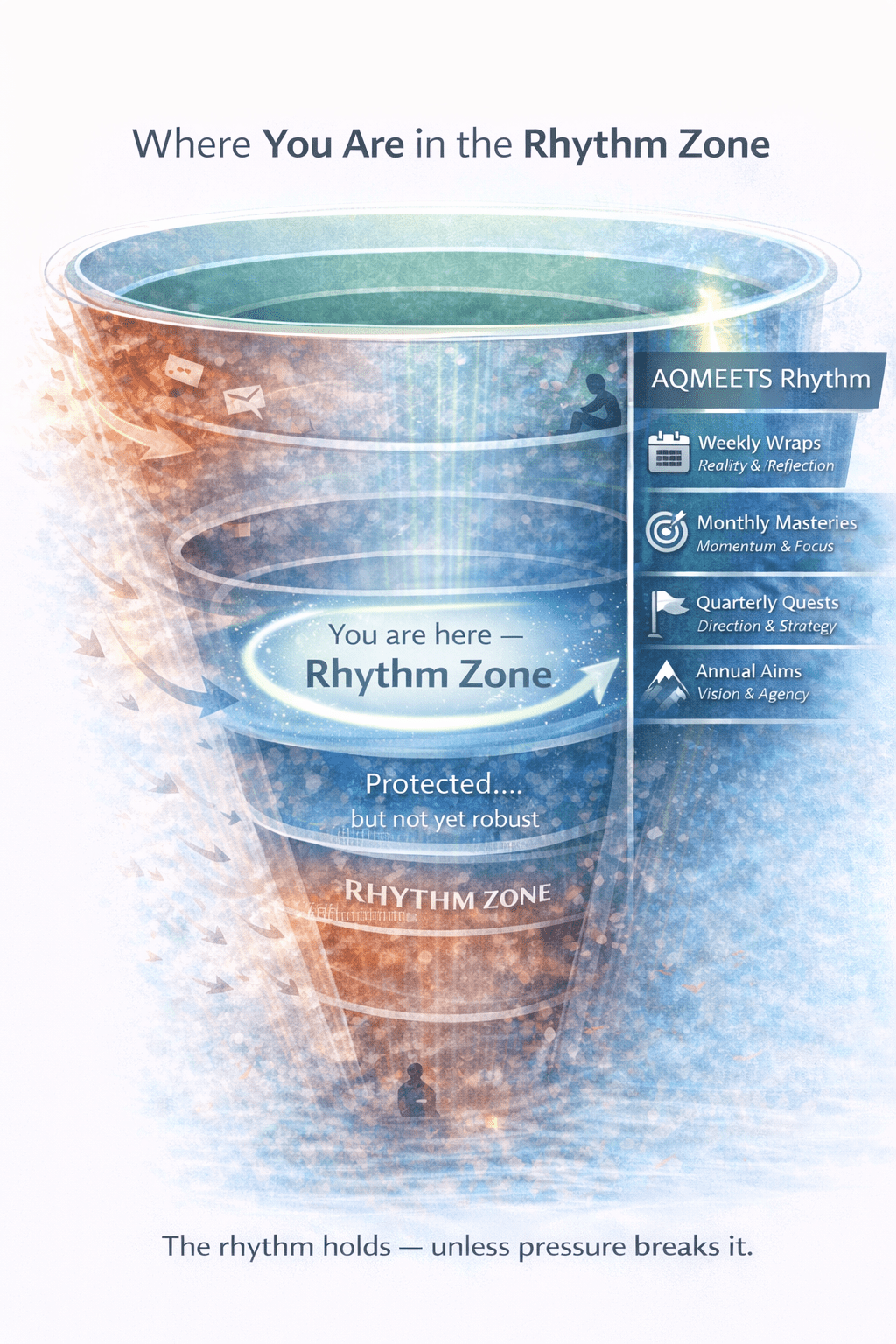
Watch this Rhythm Zone orientation.
Watch this before choosing your next step. Rhythm is real progress. The useful question now is whether the system becomes more intelligent as you use it.
A review can happen and still change very little. The important test is whether what you learn alters the next week, month or quarter. Rhythm means the feedback practice recurs. Compounding means each recurrence leaves something better behind.
Start the Free Trial and Make Your Rhythm CompoundWhat Rhythm usually means.
Rhythm Zone means the execution structure is present. The opportunity now is to turn recurring structure into accumulating results, learning and agency.
A structure that works.
You already have routines, planning habits, calendar blocks or some form of recurring review. The task is to preserve what genuinely serves you rather than replacing it with another system for its own sake.
A standard that can soften.
Because the system is functional, an important aim can remain respectable but incomplete for a long time. “Well enough” reduces the pressure to ask what should exist by now and why it does not.
Feedback that stops too early.
You may notice what happened and make sensible adjustments. The deeper test is whether the lesson becomes a specific instruction for the next cycle, rather than an observation you understand but do not operationalise.
Rhythm can plateau quietly because the system is good enough to keep producing respectable weeks. Compounding requires more: each cycle should leave stronger evidence, better judgment, or a better way of working.
“Well enough” can preserve a plateau for years.
Consistency is valuable, but consistency alone does not tell you whether the right thing is advancing. A disciplined calendar can continue serving a priority whose standard has quietly softened.
The client work is delivered. Meetings happen. The weekly review gets completed. Meanwhile, the strategic asset that should change the quarter remains half-built. Nothing looks badly broken, which is precisely why the gap can persist.
A year can contain many useful, orderly weeks and still produce less movement than the underlying capacity made possible.
The cost is often hidden inside work that is genuinely useful.
For a founder, client delivery may remain strong while the offer, sales system or strategic asset receives only leftover attention.
For a consultant, work can keep arriving while the deeper positioning or intellectual property develops in fits and starts.
For a leader, operations can remain orderly while a difficult decision is carried from month to month because the current system never forces it into evidence.
The review has to do more than recur.
At this stage, the difference is what happens to the information your rhythm produces.
Review recurs
You already return to the work with some consistency. That gives you something valuable: repeated encounters between intention and reality.
Reality issues an instruction
Feedback Analysis asks more than “How did the week go?” It asks what you expected, what actually happened, what the difference teaches, and what specifically changes now.
Learning travels
With Fractal Feedback, a lesson from the day can improve the week; repeated weekly evidence can change the month or quarter; a quarter can even challenge an Annual Aim. Experience is allowed to educate the plan.
Rhythm means the feedback practice recurs. Compounding means each recurrence leaves the system — and the person using it — better than before.
Make each cycle teach the next.
Peter Drucker’s Feedback Analysis begins with a simple discipline: state what you expect, act, then compare expectation with reality. The comparison matters because the difference should improve the next decision.
For someone already in Rhythm, additional planning has limited value unless the review produces a correction that actually enters the next cycle.
Let reality improve the next cycle.
This is the logic of Fractal Feedback. Intention moves from the year into the quarter, month, week and day. Evidence travels back through those same horizons so the larger plan can learn from lived reality.
AQMEETS Pro gives that process a recurring environment through Annual Aims, Quarterly Quests, Monthly Masteries, Weekly Wraps, Daily Directives and Peer Proof. Those practices are useful when they make feedback harder to ignore and easier to carry forward.
- What did I intend?
- What actually happened?
- What does the evidence teach me?
- What changes now?
Why the free 14-day Pro trial matters.
The free 14-day Pro trial is an audit of a system that already works. Bring your current goals, calendar, habits and review practice. Keep what genuinely serves you.
Then choose one important aim that has been progressing, but less decisively than it should. Put two real weeks under a stronger feedback process and watch what the evidence reveals.
The useful question for the trial is concrete: can your present structure produce stronger evidence on the aim that matters most this quarter — and can what you learn in Week 1 make Week 2 better?
Bring the system you already use.
Think of AQMEETS as a gym for Feedback Analysis. At Rhythm level, you are not arriving as a beginner. You bring the routine you already use into an environment built for repeated practice, stronger feedback, peer proof and scheduled return points.
Judge the trial by what changes in the work: whether the aim becomes more demanding of the calendar, whether a hidden assumption becomes visible, and whether one correction improves what follows.
You should finish with evidence about your present system. A favourable impression of a new one is not enough.
What the induction gives you.
The induction does not assume you are starting from zero. It uses the rhythm you already have as the material for examination.
See what deserves to stay.
Some of your current habits may already be doing their job well. The induction helps distinguish useful structure from structure that has become routine without producing enough learning.
Locate the first constraint.
Rather than rebuilding everything, identify the point where stronger feedback could have the greatest effect on the aim you care about now.
Define the evidence.
State what meaningful progress would look like in observable terms, so the next review has something more useful than general impressions to compare.
Bring the system you already use. Let one reviewed cycle show where it is strong, where it has become too forgiving, and what deserves to change.
When “well enough” becomes expensive.
The difficulty in Rhythm is that nothing may feel urgent enough to fix. Goals are clear enough. Review happens often enough. Focus time exists. Progress is visible.
Because the system functions, the cost of the plateau is easy to miss. A year can pass through useful weeks without producing the movement that was possible.
The next gain comes from what the rhythm learns.
At this stage, simply repeating the system more faithfully may preserve the plateau. The important question is whether each repetition improves the next one.
The feedback changes the plan. Repeated feedback changes the person. Over time, you should become better at noticing deviation, interpreting evidence, correcting deliberately and returning reliably.
What your first 14 days should do.
Use the next 14 days to see whether a stronger feedback architecture makes your existing rhythm more consequential.
Bring your present rhythm.
Bring the goals, calendar, habits and review practices you already use. There is no value in discarding something simply because it was not invented here.
Choose one important aim.
Select something that is progressing, but should have more evidence behind it by now. Define what meaningful movement would actually look like.
Put Week 1 under feedback.
Compare intention with reality. Identify the difference, the likely cause and one correction that should enter the next seven days.
Let Week 2 learn.
Carry the correction forward. The point is to see whether the second cycle becomes better informed because the first one happened.
You decide from evidence.
Did AQMEETS produce stronger evidence on the aim, expose something your old review was letting through, or improve the quality of the next correction?
The trial has done its job if you can see whether your rhythm is simply recurring or genuinely compounding — leaving behind a result, a lesson, or greater agency for the next cycle.
Which AQMEETS path fits Rhythm Zone?
For most people in Rhythm Zone, Pro is the clearest place to test the full feedback architecture before deciding what level of support is useful longer term.
Pro gives you the full Rhythm.
Annual Aims, Quarterly Quests, Monthly Masteries, Weekly Wraps, Daily Directives and Peer Proof connect the larger aim with ordinary time and give learning somewhere to travel.
Lite remains a lighter option.
If the main value you need is a lighter recurring practice, Lite may be sufficient after the trial. Your score alone should not force you into a larger plan.
Leader adds counsel when judgment is the constraint.
If your weekly rhythm is sound but the harder questions concern staff, cash flow, partnerships, major offers, organisational direction or another consequential decision, private counsel may be more useful than adding more execution structure.
Choose the level according to the decisions you are carrying. Additional support only has value when it meets a real need.
Bring the rhythm you already have.
AQMEETS should justify its place by improving what that rhythm produces.
Instead of asking only whether you stayed consistent, the review asks whether the important work moved, what reality taught you, and whether the next cycle changed because of it.
A rhythm should become wiser as it repeats.
Results should accumulate in the work itself.
Learning should survive the week that produced it.
Agency should grow as you become better at seeing, deciding, correcting and returning.
A functioning system can plateau quietly.
Nothing has to collapse for progress to flatten. The danger is subtler: the system keeps working, so the standard stops being questioned.
A year can contain genuine wins and still leave a larger question unanswered: did the repeated cycles make the work better, the decisions wiser and your capacity for self-governance stronger?
Make the rhythm you already have compound.
You already have something worth building on.
Use the trial to put one important aim inside a fuller feedback architecture and see whether the system becomes more useful because it is being tested against reality.
Use the 14 free days as a real experiment. Browsing another system would tell you very little.
Start AQMEETS Pro, bring the rhythm you already use, and let the guided induction help you identify what should stay, what needs stronger feedback and what evidence should exist next.
At the end of two weeks, judge AQMEETS by the work. Did the important aim produce stronger evidence? Did Week 1 teach Week 2 something useful? Did you leave with a better correction than the one you would have made alone? That is the beginning of Compounding.