When nobody manages your week, what keeps the important work from sliding?
See where your own priorities are getting crowded out—and what may be missing from the way you plan, protect, review and follow through.
You may be accountable to clients, staff, customers and deadlines every day.
But the work only you can protect—strategy, growth, important decisions and longer-term priorities—often has no one waiting for it.
The urgent work gets done. Everyone else gets an answer. Your own important work quietly moves to next week.
The Entrepreneur Execution Scorecard helps you see where that pattern is breaking down.
You may not need someone to manage you. You may need a stronger structure around the commitments that only you can protect.
Free • 14 questions • about 3 minutes • See your result before deciding anything else.

Everyone in the business may answer to you. Who do your own commitments answer to?
When you own the business, external accountability becomes uneven.
Clients create deadlines. Staff bring questions. Customers create consequences. Operations keep moving.
Strategy, business development, system building and longer-term priorities often do not create the same immediate pressure.
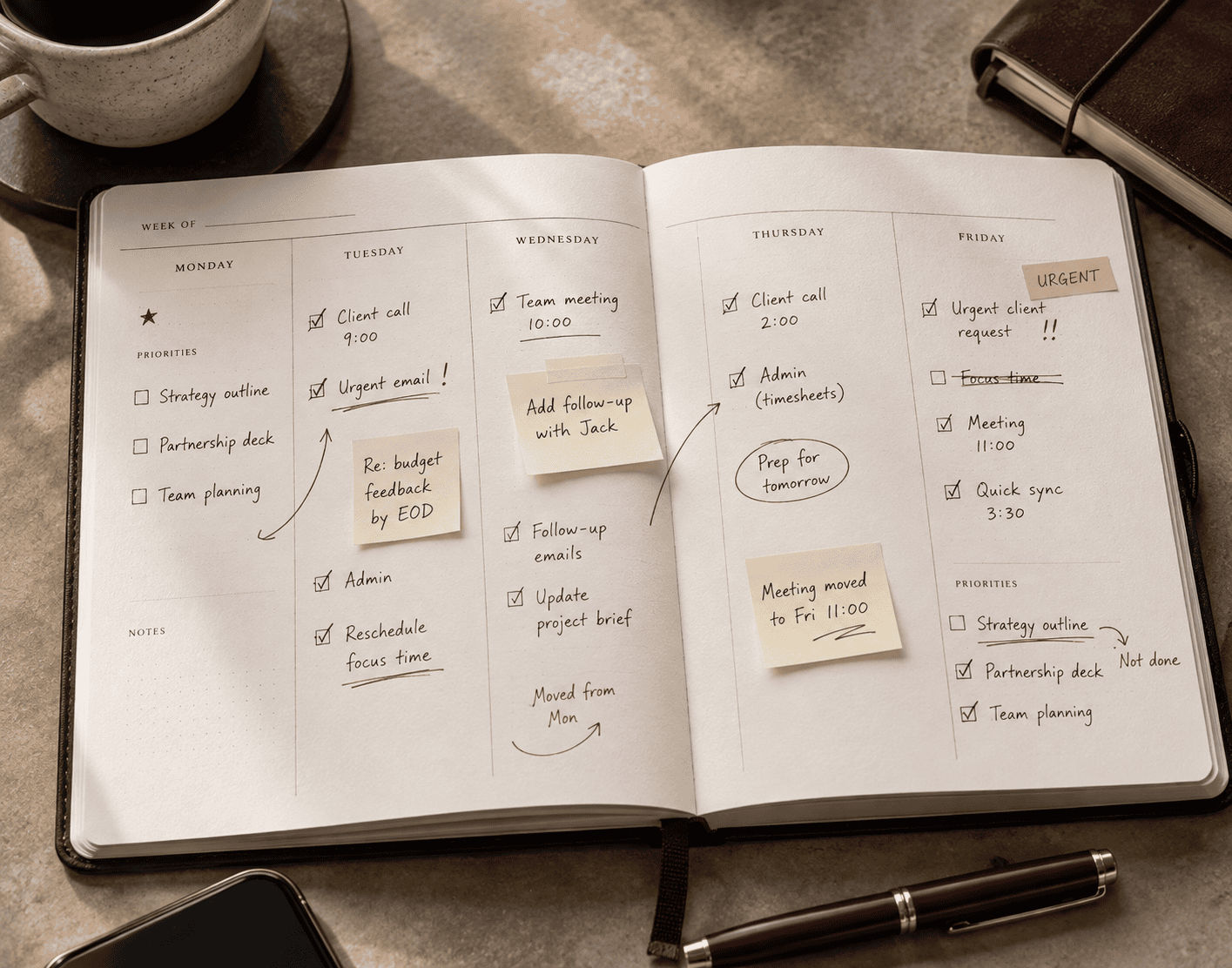
By Friday, the business may have kept moving while the work that would strengthen or grow it barely moved at all.
Client commitments may still have been met. Your own important work quietly moved to next week.
That is not necessarily a lack of discipline. It is what can happen when important owner-level work has no durable structure keeping it visible.
What is your current business-owner execution pattern?
The Scorecard looks at what happens after you decide what matters: whether owner-level priorities stay visible, important work is protected, commitments survive a reactive week, results are reviewed, and accountability helps you adjust.
Drift
Your intentions are real, but they are not yet supported by a dependable execution and review practice.
Busy
You are carrying a lot and getting things done, yet urgent work can repeatedly crowd out important work.
Rhythm
You return to your priorities regularly, compare plans with results, and correct course.
Compounding
Your shorter-term work increasingly reinforces the larger aims you have chosen.
Your result appears immediately.
Business owners need accountability without giving away ownership.
When nobody manages your week, the answer is not to recreate a boss.
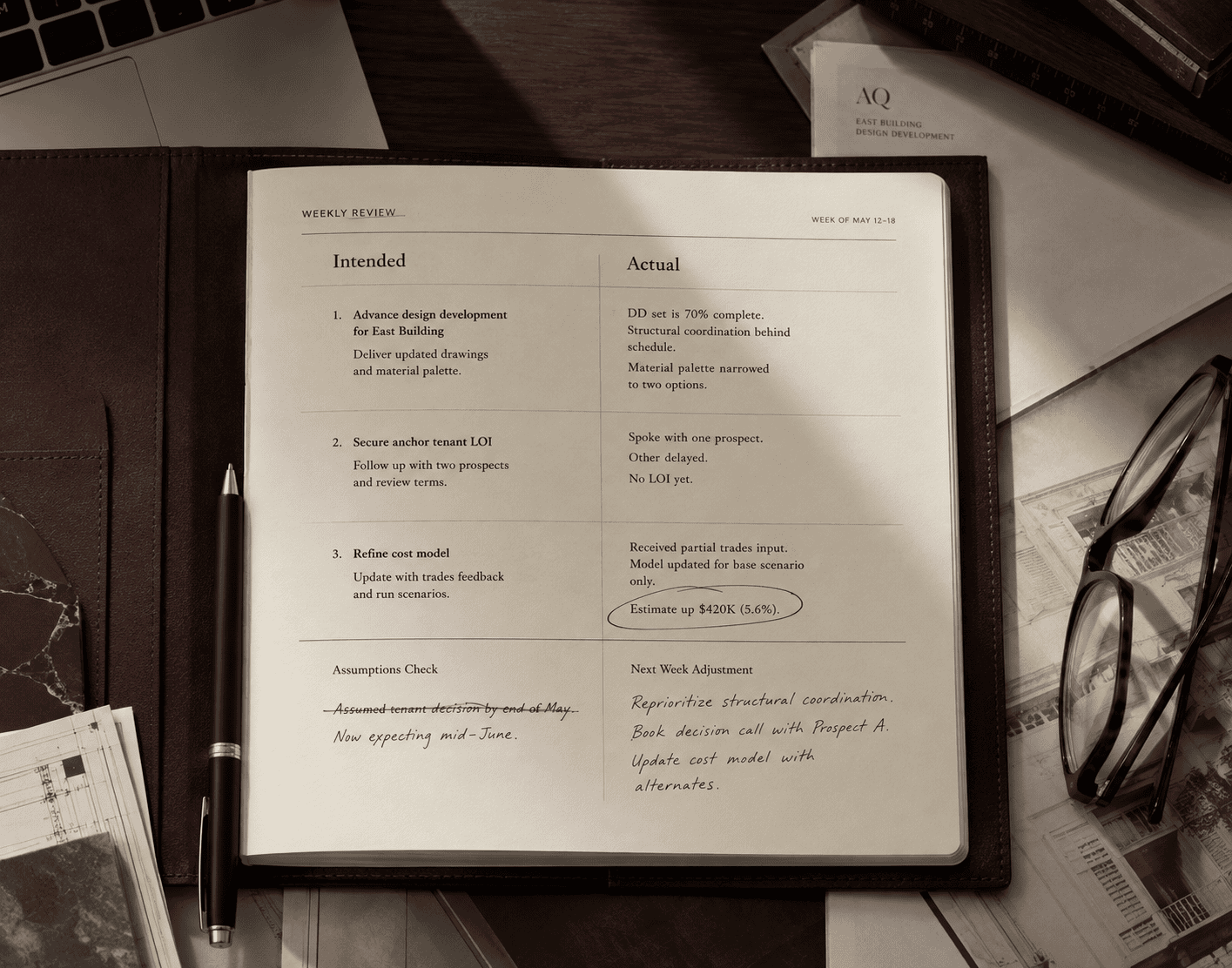
Useful accountability helps you choose the priorities, keep them visible, review what actually happened, and adjust when reality changes.
Did the work only you can do receive enough protection? What displaced it? Which commitment moved, which stalled, and why? What now deserves attention?
A useful business-owner accountability practice gives those questions a regular place without taking the decisions away from you.
You choose what matters. AQMeets gives those choices somewhere to remain visible after the week gets busy.
If everyone else’s work gets done before your own priorities, the Scorecard is worth three minutes.
You begin a month or quarter knowing what the business needs from you.
A few weeks later, clients, staff, admin and operational problems have claimed most of the available attention.
The business remains busy. You recommit to the strategic work. It improves for a while. Then the same pattern begins to return.
The Scorecard will show you whether your current working pattern looks more like Drift, Busy, Rhythm or Compounding.
Free • 14 questions • about 3 minutes
AQMeets gives business owners a recurring place to return to what only they can protect.
Rather than relying on memory, urgency or leftover time, AQMeets brings you back to your priorities at several levels.
Daily Directives
Keep immediate action visible.
Weekly Wraps
Compare intention with what actually happened.
Monthly Masteries
Step back far enough to notice the pattern.
Quarterly Quests
Return attention to the larger priorities.
Annual Aims
Reconnect shorter periods with wider direction.
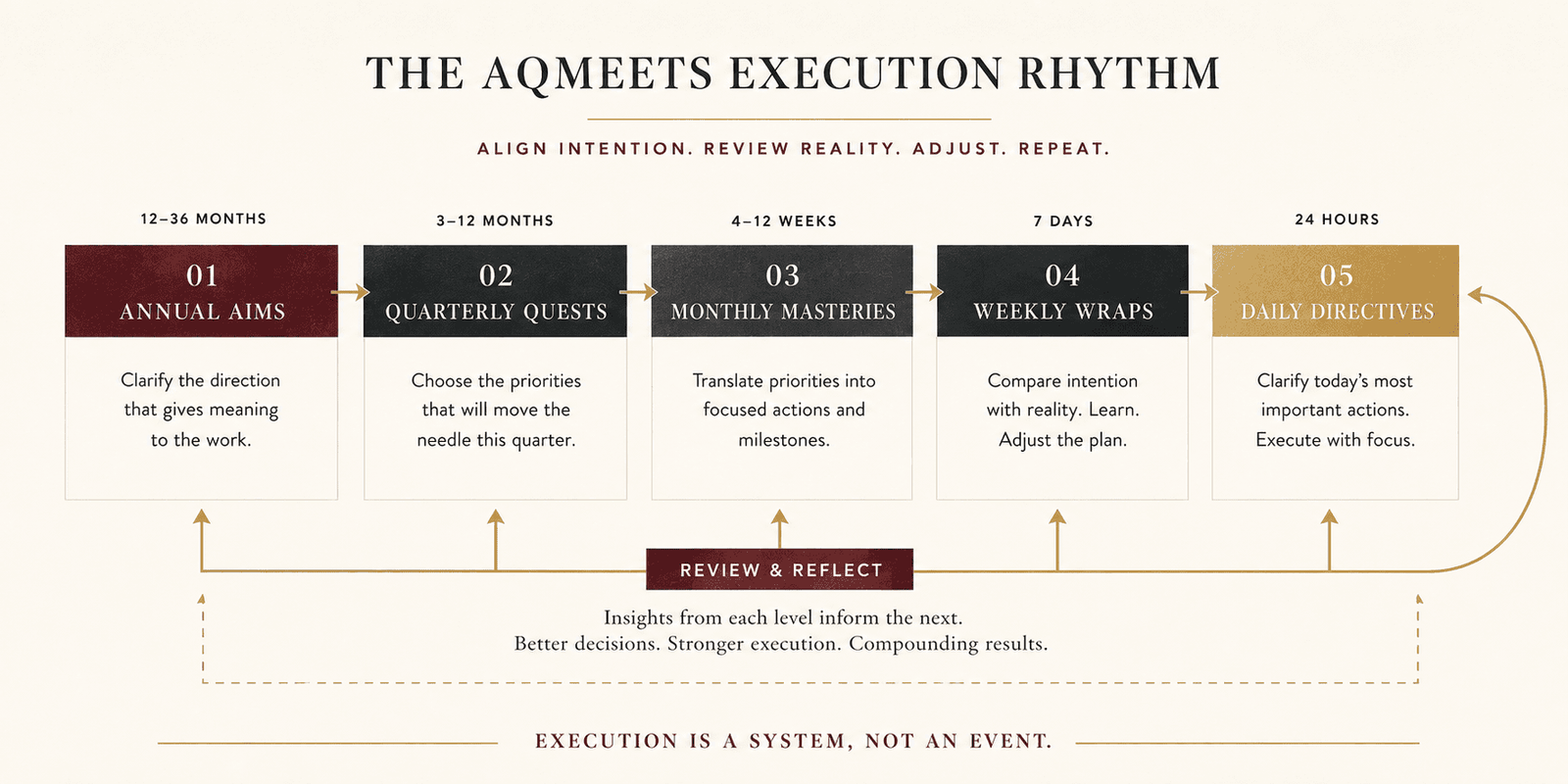
Each level informs the next. The purpose is simple: keep the plan in contact with reality long enough to improve it.
Five movements guide the review.
AQMeets uses iRAPP to turn a busy owner’s week into usable evidence.
Intention
What were you trying to accomplish?
Reality
What actually happened?
Analysis
What can you learn from the difference?
Planning
What should happen next?
Peers
Where would outside perspective help you see what you are too close to?
A missed commitment is useful information when you examine why it was missed. A completed commitment is useful too. The review turns both into better decisions.
Accountability should support your judgement, not replace it.
Business owner accountability does not mean handing your judgement to someone else or creating another person who tells you what to do.
AQMeets gives business owners a structured practice for planning, review, correction and accountability over time.
Peer participation and additional support can sit around that practice depending on membership, but ownership of the priorities remains with you.
You remain responsible for direction. AQMeets gives you a regular place to keep that direction in contact with reality.
You see your result before deciding anything else.
When you finish, you receive your Execution Zone: Drift, Busy, Rhythm or Compounding.
Your result explains the pattern suggested by your answers, where owner-level priorities are most likely slipping, and what a stronger working rhythm would involve.
You can then decide whether AQMeets is relevant to what you want to improve.
There is no need to choose a membership before seeing your result.

A few practical answers.
What does business owner accountability look like in AQMeets?
Is the Scorecard free?
Will AQMeets tell me what I should do in my business?
I already use a planner. Would AQMeets replace it?
Is AQMeets mainly about setting goals?
Is this mainly for solopreneurs?
Is there a peer component?
When nobody manages your week, make sure your priorities still have somewhere to return.
Take the Business Owner Execution Scorecard and see where important work is being protected, crowded out, reviewed or allowed to slide.
Free • 14 questions • about 3 minutes