
The Four Faculties Framework
When the week breaks down, “try harder” is usually too blunt.
AQMeets uses the Four Faculties Framework to help self-directed builders locate where execution is breaking down: Awareness, Reason, Imagination, or Will.
A vague diagnosis produces a vague correction. A vague correction rarely survives the week. That is why “I need more discipline” often fails as a useful answer.
Sometimes discipline is the issue. Other times, the week is showing a different problem: you did not see the pattern clearly, you had not chosen the real priority, you never made the correction concrete enough to carry, or you knew the right thing and still dropped it when resistance arrived.
Those are different failures. They need different corrections. You may call it procrastination when the task was never made clear, lack of focus when the main lever was never chosen, inconsistency when the habit depended on an impossible time of day, or overwhelm when the next step had no shape.
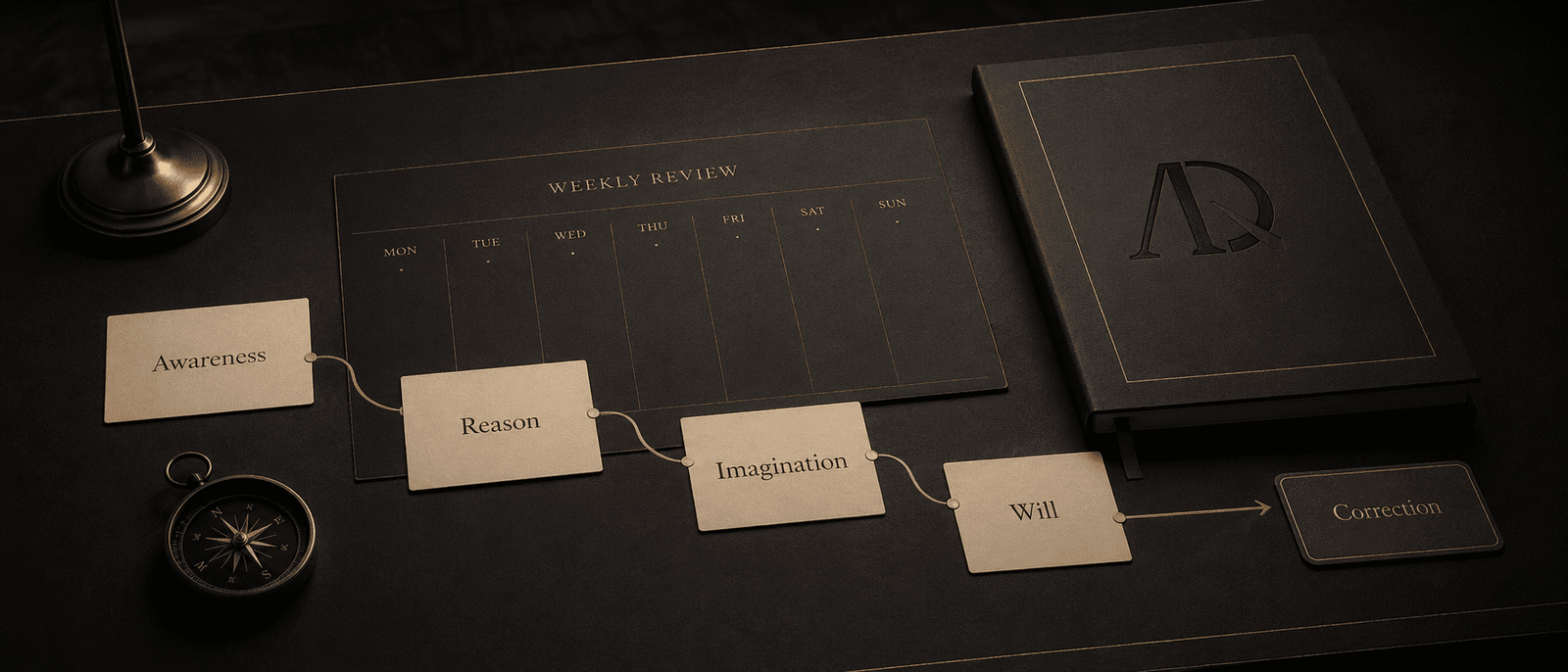
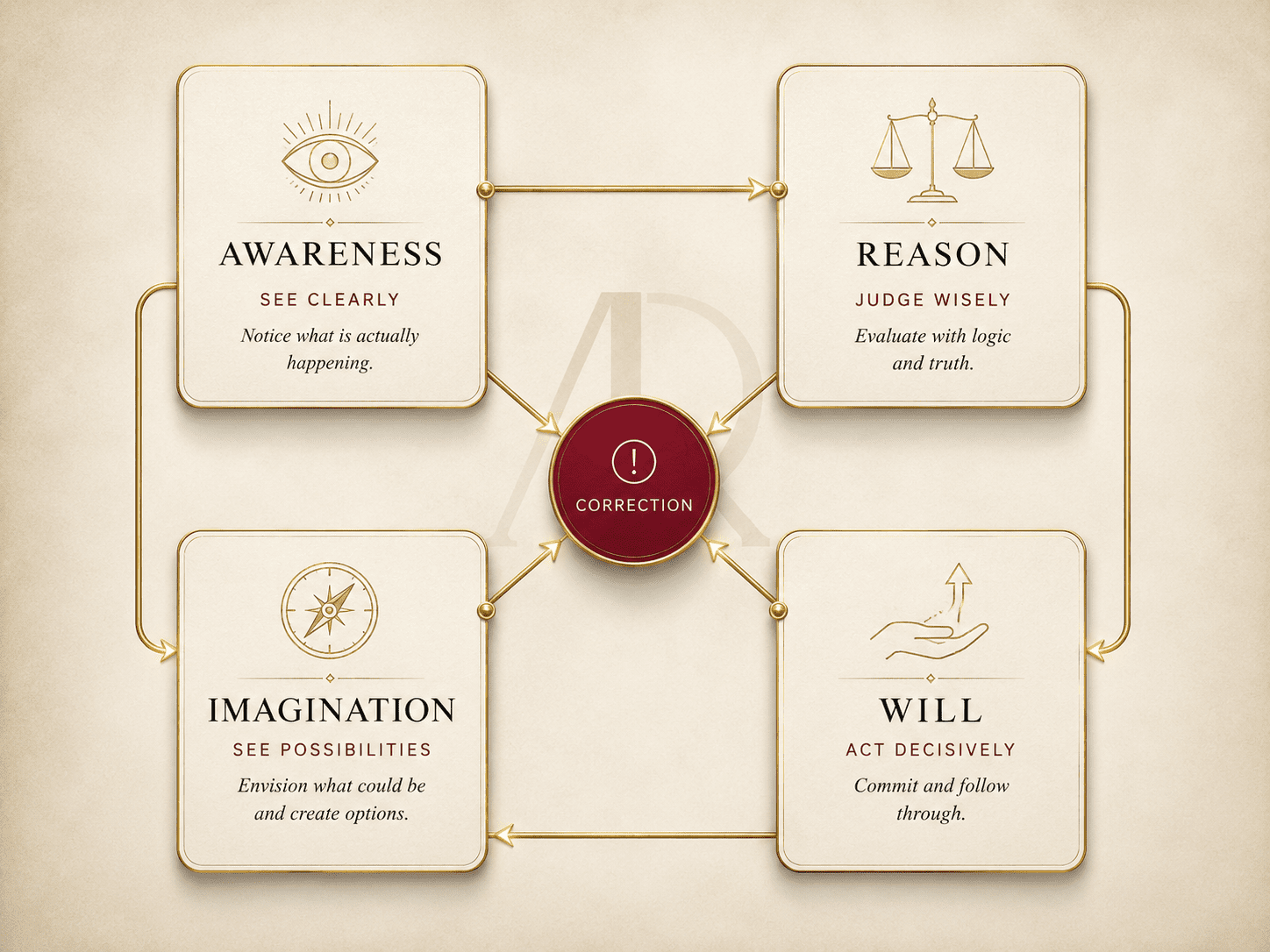
AQMeets uses the Four Faculties Framework to diagnose the week more accurately: Awareness sees reality, Reason judges what matters, Imagination forms the correction, and Will carries the choice into action.
Where did the breakdown happen?
What needs to be trained next?
The Wrong Diagnosis
Not every stalled goal is a discipline problem.
Most stalled goals are labelled too quickly. You miss the review and call it laziness. You delay the sales call and call it procrastination. You abandon the habit and call it inconsistency. You avoid the hard decision and call it overwhelm.
Those labels may describe the surface. They do not always reveal the cause. You may need less self-reproach and a cleaner diagnosis.
A person can fail to act because he never saw the real issue, did not judge the priority clearly, left the next step too vague, or met resistance with a will that was not ready to carry the choice.
These failures feel similar on Friday. They are not the same.
Which faculty failed to do its work this week?

The Blunt Remedy
More effort cannot repair every kind of breakdown.
Effort helps when the will is weak. But effort cannot notice a pattern you have not seen, choose between competing priorities, turn a vague next step into a clear action, or make a confused aim usable by Monday morning.
This is how capable people keep pushing harder and still repeat the week. They apply force where they need diagnosis.
- The task was never protected.
- The priority was never chosen.
- The first step was never pictured.
- The resistance was never anticipated.
Then Monday comes. The person resets and tells himself to be more disciplined. By Friday, the same task has moved again.
“Try harder” can become a way of avoiding a closer look.
AQMeets starts with diagnosis: what broke, where did it break, which faculty needs attention, and what correction is small enough to carry next week?

The Framework
The four faculties help you locate the breakdown.
AQMeets works with four human capacities. These are practical questions for the week.
Awareness
What happened?
Awareness notices reality.
It sees what occurred, what was avoided, what repeated, what interrupted the work, and what the week actually proved.
Breakdown symptom: you keep missing the evidence the week is giving you.
Reason
What matters?
Reason judges priority.
It separates the urgent task from the important one, the excuse from the cause, and the visible task from the meaningful lever.
Breakdown symptom: urgency chooses the week for you.
Imagination
What correction is possible?
Imagination forms a workable alternative.
It pictures the next move, the better structure, the protected time, the clearer conversation, or the different route.
Breakdown symptom: the correction stays vague.
Will
What will I carry?
Will chooses and continues.
It carries the correction into action when resistance, fatigue, distraction, or fear arrives.
Breakdown symptom: you know the correction and still do not carry it.
Faculty One
Awareness sees the week without editing it.
The first failure is often seeing. A person cannot correct a pattern he does not notice. He may remember being busy, pressure, and a few interruptions, but he may not see the actual pattern.
- The task moved three times.
- The hard call was avoided after lunch every day.
- The first clear hour went to messages.
- The habit failed whenever the evening was left unstructured.
- The proposal was opened twice and never sent.
Awareness brings the week into view by asking what actually happened, what repeated, what was avoided, and where the week gave evidence.
Without Awareness, the person lives inside the blur.
With Awareness, the week becomes visible enough to review.

Faculty Two
Reason judges what matters when everything is asking for attention.
A week can be full and still poorly judged. The urgent task asks loudly, the meaningful task waits quietly, the easy response feels responsible, and the harder lever feels inconvenient.
Reason asks:
- What matters most here?
- What is the real cause?
- What is the highest aim?
- What deserves protection?
- What should be refused?
Without Reason, the person may be active, helpful, and praised while the deeper work keeps losing. He may move all week and still leave the main lever untouched.
Reason brings order to pressure. It helps the builder decide what deserves command when the week starts pulling.

Faculty Three
Imagination gives the correction a usable shape.
Many people see the problem and still cannot move. They know the week drifted, the priority matters, and the old pattern is costly. The correction still sounds like this:
- I need to focus more.
- I need to be more consistent.
- I need to stop avoiding this.
Those sentences may be true, but they are not yet usable. Imagination makes the correction concrete.
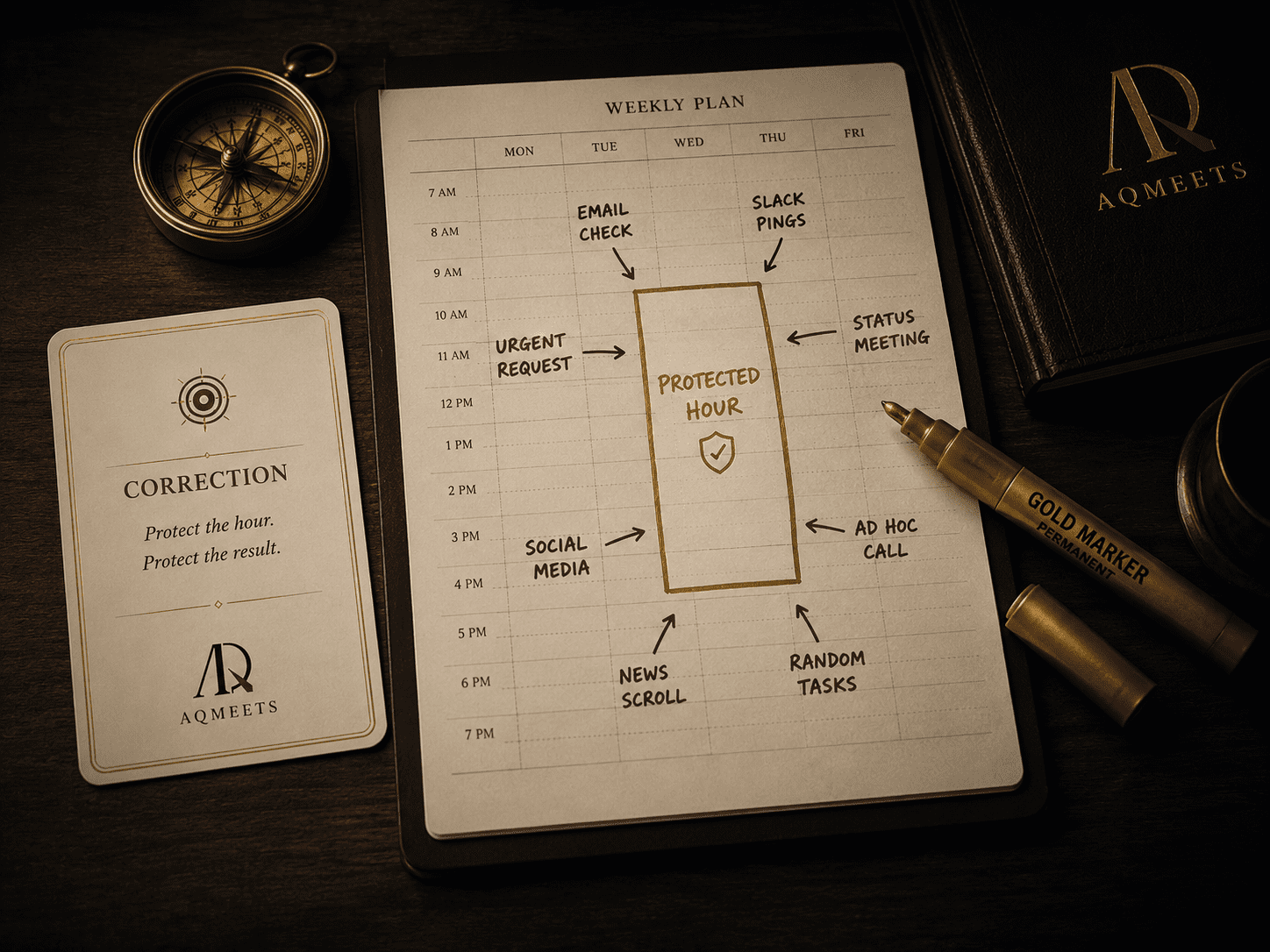
- A protected first hour.
- A smaller send point.
- A clearer conversation.
- A visible proof standard.
- A different cue for the habit.
- A simpler next action.
Without Imagination, the person can understand the problem and remain trapped in the old shape of the week.
With Imagination, the next week begins to have a different form.

Faculty Four
Will carries the correction when the week resists.
A correction is not real because it sounds right. It becomes real when it is carried. That is the work of the will.
The will acts when the message arrives, when the body wants relief, when the harder task feels exposed, when the old shortcut looks easier, and when the decision would cost comfort.
Will is chosen continuation. It does not require the person to feel heroic. It asks him to carry the correction he already chose. In AQMeets, will is trained through a weekly rhythm of proof.
- What did I choose?
- What did I carry?
- Where did I drop it?
- What must be protected next time?
Without Will, review stays theoretical. With Will, correction enters the week.
The Integration
Do not ask the will to carry what the other faculties have not prepared.
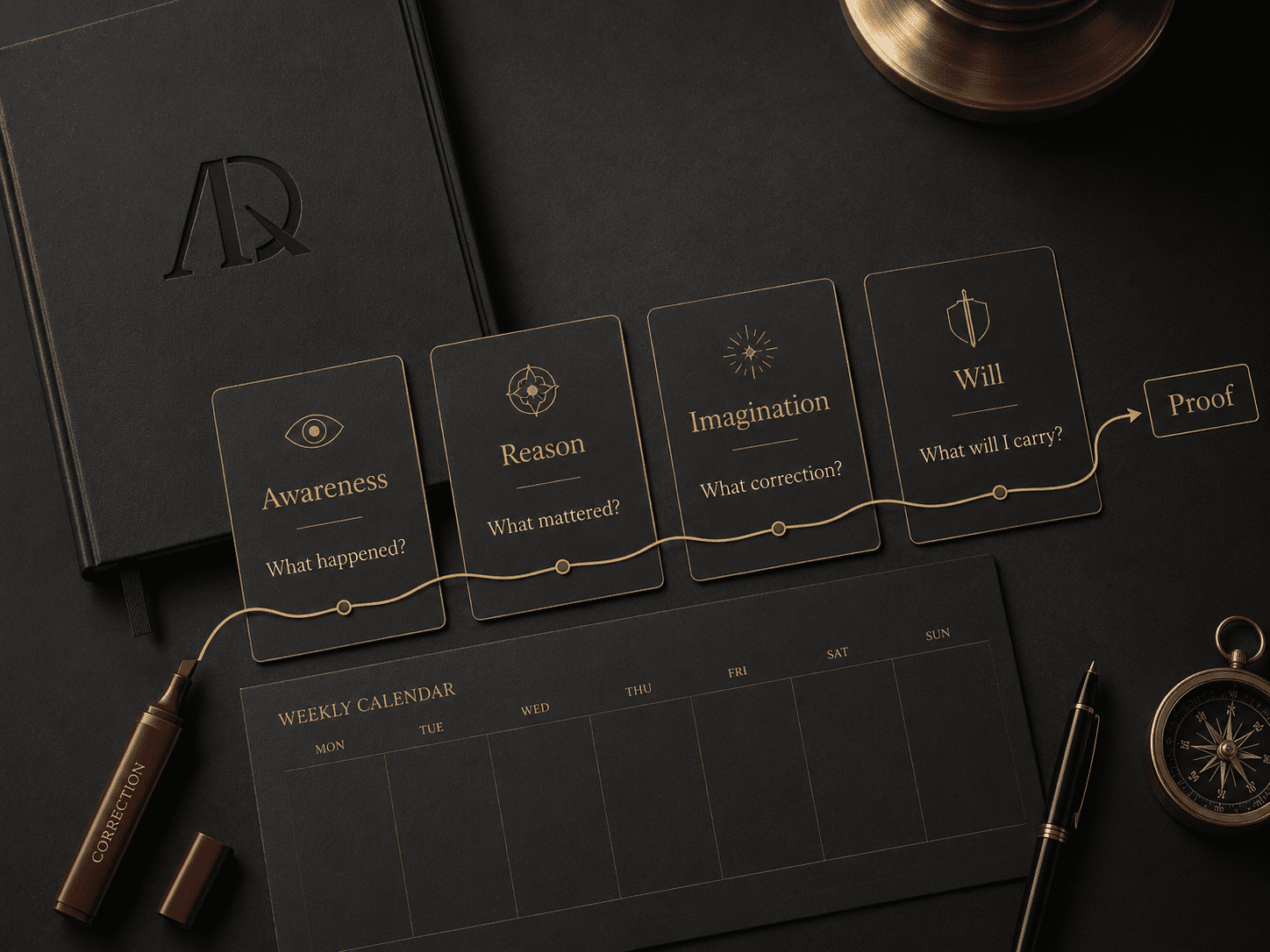
The four faculties form a sequence of correction.
Awareness
Sees what happened.
Reason
Judges what matters.
Imagination
Forms the next correction.
Will
Carries it into the week.
When one is missing, the review weakens. Awareness without Reason can produce observation without judgment. Reason without Awareness can become theory detached from the actual week. Imagination without Reason can create attractive plans that do not fit the aim. Will without Imagination becomes force without form.
Do not ask the will to carry what Awareness has not seen, Reason has not judged, and Imagination has not formed.
AQMeets brings the faculties into one weekly rhythm: see clearly, judge rightly, form the correction, carry the choice, then return next week and review the evidence.

The AQMeets Method
The Weekly Wrap prevents the Four Faculties from remaining theory.
AQMeets brings the faculties into weekly review. Awareness asks what actually happened. Reason asks what mattered and why drift occurred. Imagination asks what correction would make next week different. Will asks what must now be carried.
The Weekly Wrap is more than a review form. It is a place to practise seeing, judging, forming, and carrying. The review is not finished when the faculty is named; it is finished when the correction is chosen.
Vague intention becomes reviewed action.
The week begins to change.
What Begins to Change
Better diagnosis makes better correction possible.
When every breakdown is called lack of discipline, the remedy becomes blunt. When the faculty breakdown is named, the correction becomes more precise. The change is practical.
Before:
I need discipline.
After:
I need to protect the first hour, send the proposal by 10am, and remove the vague task.
That is the difference between self-reproach and usable correction.
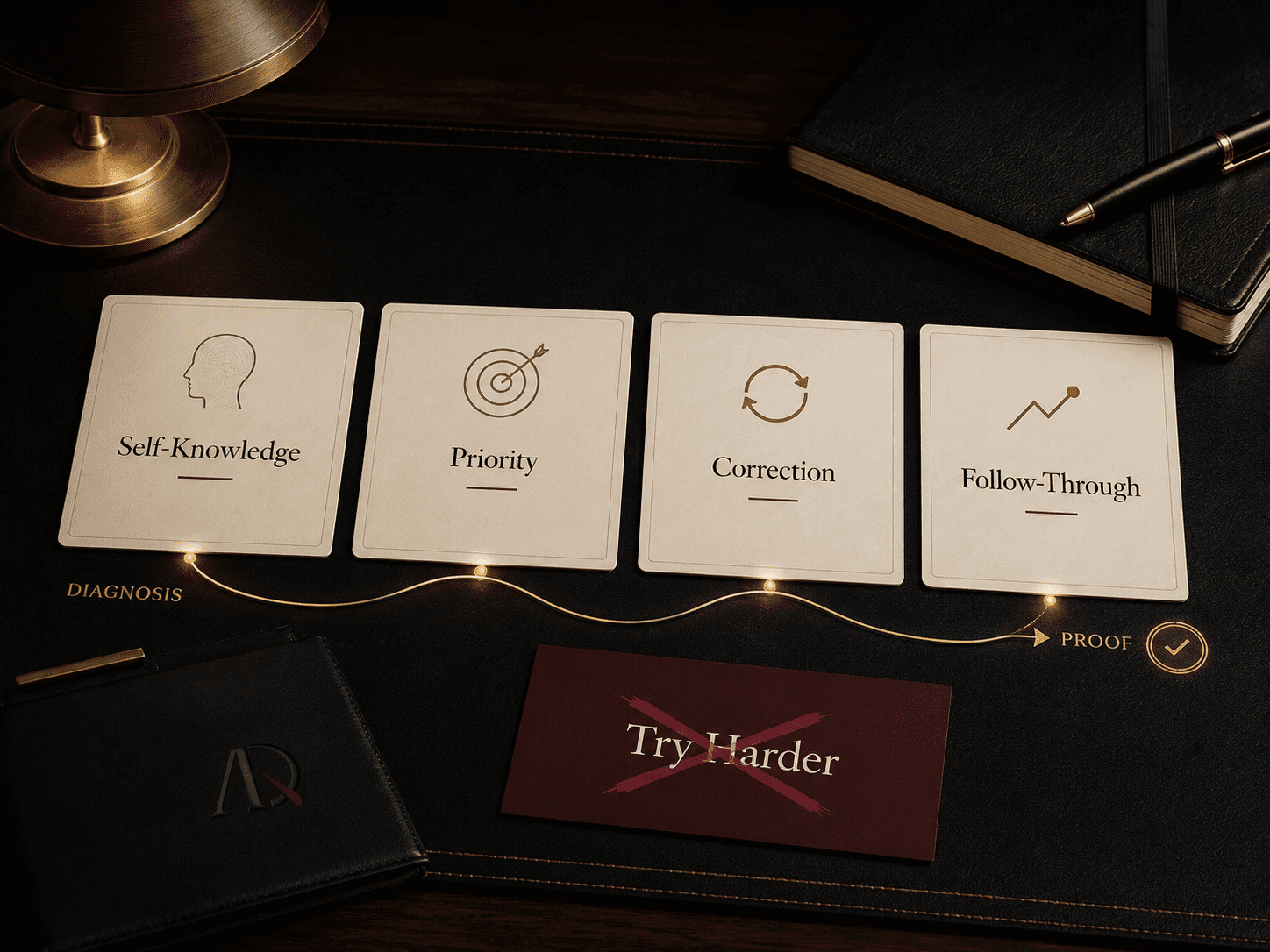
Clearer Self-Knowledge
You stop guessing why the week failed.
You begin to see whether the issue was awareness, judgment, imagination, or follow-through.
Better Priority Command
Reason helps you stop letting the loudest task govern the week.
The meaningful lever becomes easier to protect.
More Workable Corrections
Imagination helps you form corrections small enough to carry and concrete enough to test.
Stronger Follow-Through
Will becomes less dependent on mood because the correction has already been seen, judged, and formed.
Who This Is For
For builders who need a more precise diagnosis than “try harder.”
This is for founders who keep pushing the same important work forward and need to know where the breakdown really happens; consultants who can diagnose a client’s problem but need a clearer lens on their own week; coaches and advisers who understand reflection but want a stronger structure for correction; and operators whose weeks are busy but whose larger aim keeps losing command.
It is for self-directed builders who are done treating every stalled goal as one vague failure of discipline. AQMeets gives them a practical way to ask:
Did I see clearly?
Did I judge rightly?
Did I form the correction?
Did I carry it?
That is where the Four Faculties become useful.
Founder
Operator
Consultant
Adviser
Coach
Independent Professional
Small Business Owner
Self-Directed Builder

How to Begin
Start by finding where the week broke down.
You do not need to analyse your whole life today. Start with the week.
Take the Execution Scorecard if you are still trying to see your current execution pattern. Join AQMeets Lite Free if you are ready to begin a rhythm of review and correction.
Take the Execution Scorecard
See where your current execution pattern is breaking down.
Find whether you are in Drift, Busy, Rhythm, or Compounding.
Use the result as a mirror.
Take the ScorecardJoin AQMeets Lite Free
Begin a weekly rhythm that helps you see, judge, form, and carry one correction.
Bring the week to the table.
Name the faculty breakdown.
Correct one thing.
Join AQMeets Lite Free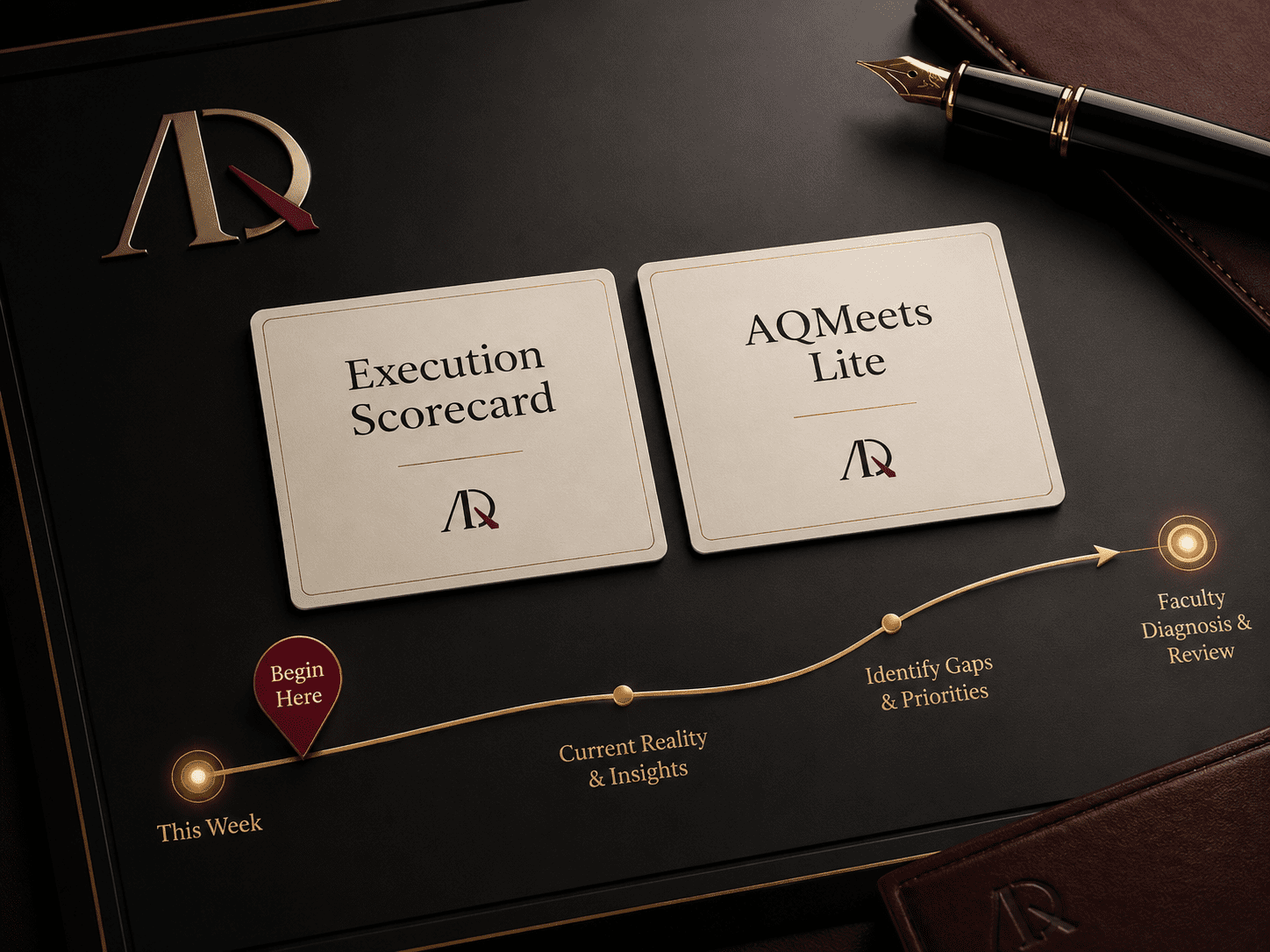
See. Judge. Form. Carry.
Do not call every stalled week a discipline problem.
The week may be telling you something more precise. Maybe you did not see the pattern, did not judge the priority, never made the correction concrete, or asked the will to carry what the other faculties had not prepared.
AQMeets helps you bring the week under review.
See what happened.
Judge what matters.
Form the correction.
Carry it into the next week.
Then return and review the proof.